Cassowary Coast delivers 2026-27 Budget
Published on 25 June 2026
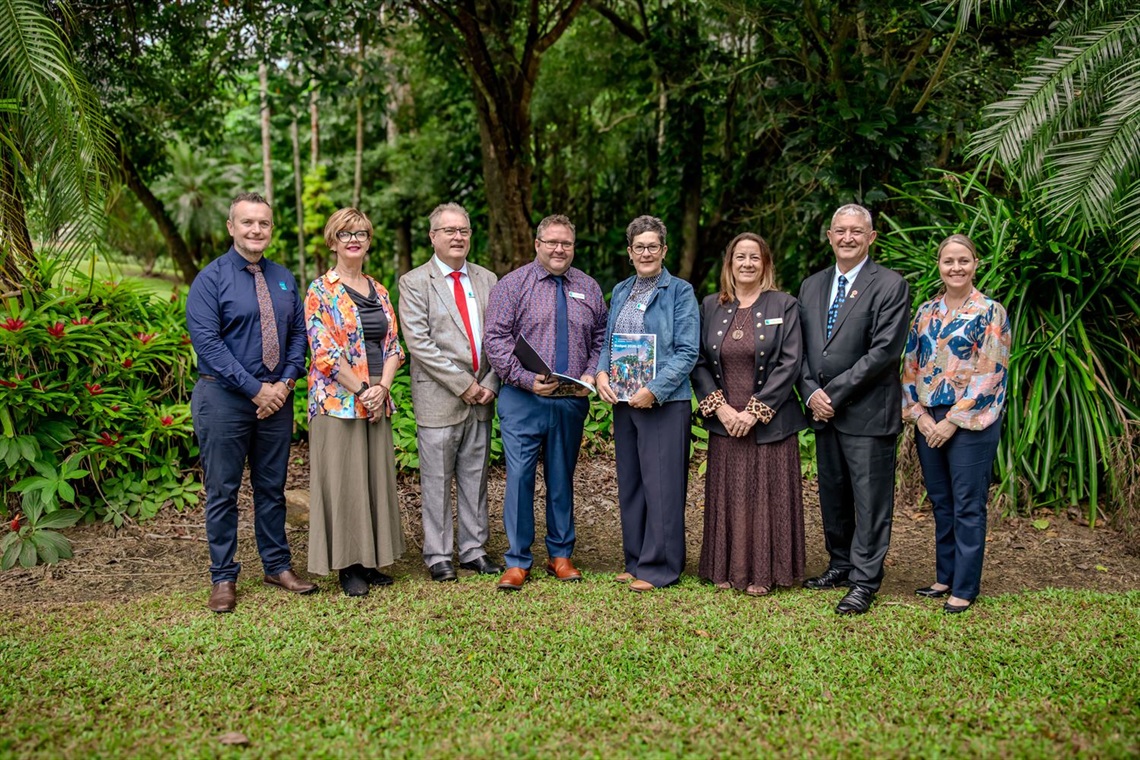
Flood resilience, infrastructure, town centres investment, free waste vouchers: Cassowary Coast delivers 2026-27 Budget
The Cassowary Coast Regional Council today adopted its 2026-27 Budget – an economically responsible and community-focused $196.8 million financial plan that prioritises investment in the region’s flood resilience, infrastructure, and town centres without unduly burdening ratepayers at a time of rising costs.
We will invest $80.66 million for capital works to mitigate flood risks; renew roads, footpaths and bridges; and renew water infrastructure for the benefit of our whole community.
$38 million of this investment is coming from external sources – not from ratepayers.
Key items within the $80.66 million capital investment include:
- Over $30 million to upgrade unsealed roads to sealed roads; renew sealed roads and bridges; and install new and wider footpaths. Road upgrades include Bowen Street, Jubilee Road, Scougall Road, Granadilla Road, and Stephenson Road.
- Almost $20 million secured through Disaster Relief Funding Arrangements (DRFA) to restore essential infrastructure following recent severe weather events.
- $8.36 million to renew our water infrastructure. Maintaining this network – around $212 million worth of assets – is one of Council’s biggest responsibilities and one of the largest costs to the community. We are also investing $6.18 million to maintain our sewerage infrastructure.
- Over $4 million to deliver vital drainage upgrades across the Cassowary Coast, including in Cardwell; Castor Street in Mourilyan; Flying Fish Point basin outlet; Koda and Kwila Streets in Wongaling Beach; and Gregory Street in Silkwood. We’ll also progress solutions for Mill Street in Mourilyan and Goondi Bend in Innisfail, and we’ve established a drainage reserve fund to help us find solutions for other impacted areas.
- Over $4 million for the Innisfail CBD to reseal roads, increase all-day parking, refresh line markings, upgrade intersections, introduce lush tropical planting and illuminating trees, and improve the safety and accessibility of footpaths.
- We will continue to develop Daradgee Estate and Eaton Estate, supported by $9.6 million in external funding in 2026-27, which will increase the supply of well-located, flood-resilient housing while preserving the unique character of our region.
Other budget highlights include:
We have allocated $116 million for core operations and services including but not limited to swimming pools, libraries, stinger nets, emergency management, community grants, economic development, environmental initiatives, maintaining buildings and open spaces, and cemeteries.
We are retaining the discount for ratepayers who pay their rates on time because we understand how the discount helps to minimise financial impacts, especially during the current economic climate.
We have kept the general rates rise within inflation, with owner-occupied general rates to increase by five per cent. For most owner-occupiers, this means the average general rate increase will be $90 per year or $1.73 per week.
For non-resident owners of residential properties, the increase to their general rates will be 10 per cent.
Rate capping has been removed for 2026-27 because revaluations have not been issued by the independent Queensland State Valuer General.
Throughout the year, we’ve engaged extensively with graziers, cane farmers and banana growers. We’ve heard that all primary producers in our region are feeling the economic effects arising from the Middle East conflict. The rate in the dollar has increased by five per cent for all primary production categories and remains the same across all categories. Clear, transparent pricing is always available on our website.
We have kept increases to water and waste charges to recover costs only.
For waste, there is a 5.5 per cent increase and for most residential ratepayers, this equates to an extra $37 per year or 71 cents a week.
We are also providing two free waste vouchers per year – one voucher in each rates notice – to support residents to prepare for the wet season and to help with clean-ups.
For water, there is a 15 per cent increase for water consumption under 300kL and for most residential ratepayers this equates to an extra $38 per year or 73 cents a week. We’ve tried hard to keep water charges down. However, we must invest in the renewal of ageing infrastructure.
The non-cash deficit of $3.086 million is in line with our Financial Sustainability Strategy 2025–2030, which identified a planned operating deficit through to 2032. The deficit is driven by depreciating assets, and it is equal to planned external funding for asset renewals. Therefore, we have chosen not to increase rates to renew assets for which we have secured recurrent external funding.
We remain in a strong cash position, with our net budget position of $49 million primarily coming from external grants and subsidies, demonstrating strong financial performance and accountability.
Budget 2026-27 documents – including the full list of capital projects, financial statements, operational plan, and updates to fees and charges – are available on our website.
Ends.
Picture caption: Cassowary Coast Regional Council adopts Council’s 2026-27 Budget. From left to right: CEO Andrew Graffen, Councillor Trudy Tschui, Councillor Chris Littlemore, Deputy Mayor Nicholas Pervan, Mayor Teresa Millwood, Councillor Ellen Jessop, Councillor Jeff Baines, and Councillor Renee McLeod
Quotes attributable to Cassowary Coast Mayor Teresa Millwood:
“This year’s $196.8 million budget reflects the Council’s values – to make it better, be courageous, be accountable to our community, work smarter, and grow our own – and keeps us moving towards making the Cassowary Coast the most liveable tropical community.”
“In developing the budget, we have listened closely to our community, businesses, and primary producers to deliver a financial plan that priorities investment in the region’s flood resilience, infrastructure, and town centres while at the same time minimising the impost on ratepayers during a time of rising costs.”
“While we’re the wettest region in Australia, significant weather events in recent times have impacted our communities and tested our resilience. A major priority in this year’s budget is to mitigate flood risks and strengthen flood resilience in key locations – and we’re doing this through a $4 million investment that will deliver vital drainage upgrades across the Cassowary Coast. We’ve also established a drainage reserve fund to deliver identified solutions for other impacted areas.”
“Waste collection costs have been heavily impacted by fuel price increases, and they continue to escalate. It’s the same situation for all Councils – no one has been immune to the effects of the Middle East conflict. We’ve worked hard to identify efficiencies to keep costs down. Plus, to support residents to prepare for the wet season and to help with clean-ups, we are providing two free waste vouchers per year.”
“Maintaining our water infrastructure is one of Council’s biggest responsibilities, and one of the largest costs to the community. We’ve tried very hard to find ways to keep water charges down. However, we have inherited ageing infrastructure, and we must invest in its renewal. Maintaining water infrastructure is a major issue for all Councils, not just us, and we believe it’s unfair to pass on rising costs to ratepayers when the state needs to contribute. We will continue to advocate for a better deal for local government.”
“The non-cash deficit is solely the cost of our depreciating assets. We’ve deliberately decided to balance the deficit with the external funding we’ve received to renew assets, instead of pushing an extra cost onto ratepayers. This is the first year we’ve been able to do this, and a deliberate decision we’ve made as a Council to minimise impacts on our ratepayers.”